
Light Year Conversion
Convert light years (ly) to metric, imperial, and other astronomical distances instantly. Ideal for astronomy and space exploration.
Metric units
Other Astronomical units
Imperial/US units
Conversion Summary
A light year is one of astronomy’s most used distance measurements — yet converting it into usable units like kilometers, miles, or astronomical units by hand is painfully slow. This free light year conversion calculator handles every unit in seconds, with high precision output across metric, imperial, and astronomical scales.
Quick Definition: A light-year is the distance that light travels in one year through a vacuum. It equals approximately 9.46 trillion kilometers (9.46 x 10¹² km) or 5.88 trillion miles. Used by astronomers to express interstellar and galactic distances, it is a unit of length — not time.
What a Light-Year Actually Measures (and Why the Definition Matters)
Most people assume a light year is a unit of time. It is not. It is a unit of length — specifically, the distance light travels in one year at the constant speed of light (approximately 299,792 km per second).
This distinction matters because conversion between light-year to metre, kilometer, or astronomical units requires multiplying travel time by the speed of light. Without a precise definition anchored to the IAU standard, your calculation will drift.
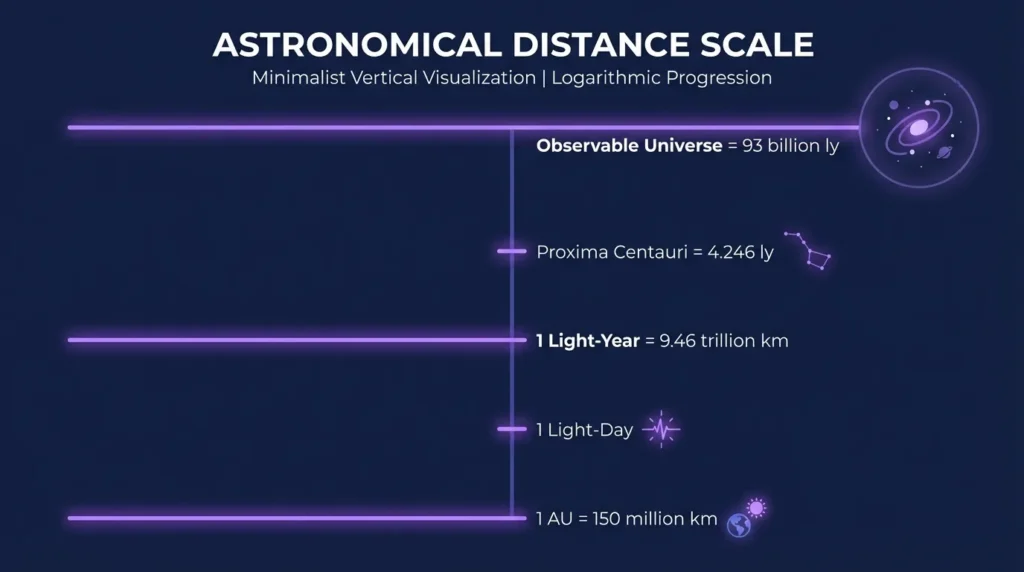
For context: one astronomical unit (1 AU) equals the average distance between the Earth and the Sun — roughly 93 million miles or 150 million km. One light-year equals approximately 63,241 AU. That gap illustrates just how vast interstellar space really is.
If you regularly work with unit measurement at smaller scales, our Length Converter handles terrestrial length units cleanly.
The Distance Light Travels in One Year: Conversion Details About Light-Year to Every Unit
The core conversion is built on one constant: the speed of light per year.
Base value:
- 1 light year = 9,460,730,472,580.8 km
- 1 light year = 9.46 x 10¹⁵ meters
- 1 light year = 63,241.077 astronomical units (AU)
- 1 light year = 0.3066 parsecs (pc)
- 1 light year = 5.879 x 10¹² miles
- 1 light year = 3.104 x 10¹³ feet
The multiply formula:
Distance in km = Light Years x 9,460,730,472,580.8
To convert light year to parsecs: Distance in pc = Light Years x 0.3066
To find AU: Distance in AU = Light Years x 63,241.077
This tool also handles extended units: light-day, Sun radii (R☉), Earth radii (R⊕), mega light-years (Mly), mega parsecs (Mpc), nautical miles, kilofeet, and yards — making it a true multiple conversion hub.
Limitations to know:
The light-year is defined using the Julian year (365.25 days exactly), not a calendar year. Results assume travel through a perfect vacuum. In real astrophysics, gravitational lensing and media density affect actual light travel. For scientific research, always cite your source definition. This tool uses the standard IAU-aligned value of approximately 9.46 trillion kilometers.
Proxima Centauri: A Named Conversion in Action
Proxima Centauri is the closest star to our solar system, sitting 4.246 light-years away. Here is the exact conversion walk-through:
Step 1 — Convert to kilometers: 4.246 x 9,460,730,472,580.8 = 40,156,538,146,539 km (roughly 40.16 trillion km)
Step 2 — Convert to astronomical units: 4.246 x 63,241.077 = 268,501 AU
Step 3 — Convert to parsecs: 4.246 x 0.3066 = 1.302 pc
Step 4 — Convert to miles: 4.246 x 5,878,625,373,183.6 = 24,957,382,584,557 miles (roughly 24.96 trillion miles)
This is exactly what the tool computes — instantly — when you type 4.246 into the light years field. No manual multiply required.
For comparison, our Astronomical Unit Calculator is ideal if you are starting from AU rather than light-years.
Common Mistakes When You Convert Light Year Values
Confusing light-years with light travel time. A spacecraft traveling to Proxima Centauri does not arrive in 4.246 years. At current speeds, it would take tens of thousands of years. Light-years measure distance, not flight duration.
Using the wrong year definition. Some older references use a tropical year (365.2422 days). The standard today is the Julian year (365.25 days). The difference is small but compounds at galactic scales — for example, when working with million light-years or distances to the observable universe edge (~46 billion light-years).
Forgetting parsec relationships. Many users mix up parsecs and light-years. One parsec = 3.2616 light-years, not the other way. Our tool shows both simultaneously so you never need to guess.
Oort Cloud and scale confusion. The Oort Cloud begins at roughly 2,000 AU but extends to about 1-2 light-years from the Sun. Users often underestimate this scale when doing manual conversion between light-year to metre or AU values.
For area-related unit work alongside your astronomy projects, the Ares to Hectares Converter handles land measurement conversions cleanly.
How to Use the Light Year Conversion Calculator
Based on the tool interface:
- Enter your distance in the “Distance in Light Years” field at the top. Type any value (e.g.,
2or4.246). - Review Metric Units — the tool instantly shows your distance in kilometers and meters. Use the dropdown under “More metric units” to switch between centimeters (cm), decimeters (dm), and millimeters (mm).
- Check Other Astronomical Units — see your result in astronomical units (AU) and parsecs (pc) simultaneously. The “More astronomical units” dropdown expands to Sun radii (R☉), Earth radii (R⊕), mega light-years (Mly), and mega parsecs (Mpc).
- View Imperial/US Units — distance in miles and feet are shown side by side. The dropdown adds inches (in), yards (yd), kilofeet (kft), and nautical miles (nmi).
- Hit “Calculate Conversion” — the Conversion Summary at the bottom confirms your result in a clean, readable format (e.g.,
2 ly = 1.892146e+13 km). - Use Reload, Clear, Print, or Share buttons below the summary as needed.
Why This Tool Delivers High Precision Conversion from Light-Year
This calculator uses the IAU-standard light-year value for all base conversions — the same constant used in academic physics and professional astronomy. Every unit output is computed from that single anchor, so results stay internally consistent across all displayed fields.
The tool is 100% free, requires no login, and works on mobile and desktop. It covers the full length units spectrum — from millimeters to mega parsecs — in one interface. No other length converter on the web gives you metric system, imperial, and deep-space astronomical units in a single page view.
FAQs About Light Year Conversion
How many kilometers is one light year?
One light year equals approximately 9.46 trillion kilometers (9,460,730,472,580.8 km). This is the distance light will travel through a vacuum in one Julian year (365.25 days) at the constant speed of light.
What is the difference between a light-year and a parsec?
One parsec equals 3.2616 light-years. Astronomers use parsecs in technical data because they relate directly to stellar parallax measurements, while light-years are more common in public science communication. This tool shows both simultaneously for easy comparison.
Can I use this tool to convert light-year to metre?
Yes. The “Distance in meters” field in the Metric Units section handles conversion between light-year to metre directly. For 1 light year, the output is approximately 9.461 x 10¹⁵ meters. The “More metric units” dropdown also gives centimeters, decimeters, and millimeters.
What is a light-day and does the calculator support it?
A light-day is the distance light travels in one day — roughly 2.59 x 10¹⁰ km. While the tool’s primary input is in light-years, the extended astronomical unit dropdown includes mega light-years (Mly) for scaling up, and all outputs can be manually scaled down. For direct light-day conversion, divide your light-year input by 365.25.