
Power to Weight Ratio
Your vehicle’s performance comes down to one number: its power-to-weight ratio. This free calculator gives you six performance metrics instantly — no spreadsheets, no manual equations.
Whether you’re comparing cars, checking LAMS limits, or optimising a racing build, this tool delivers accurate results in seconds.
Understanding the Power-to-Weight Ratio
Horsepower means nothing without context. A 500 hp truck and a 500 hp sports car perform very differently. The difference? Weight.
The power-to-weight ratio (PWR) tells you how much power is available per unit of mass. It directly predicts how fast a vehicle can accelerate, handle corners, and climb hills.
The core formula is simple:
PWR = Power Output ÷ Vehicle Weight
In practice, calculating this across multiple units — kW, hp, kg, lbs, tonnes — is tedious and error-prone. That’s why engineers, drivers, and enthusiasts use a dedicated ratio calculator instead of doing it by hand.
Real-world scenarios where PWR matters:
- P-Plate / LAMS compliance: Australian provisional licence holders must drive vehicles under 130 kW per tonne. Getting this wrong has legal consequences.
- Drag racing builds: Teams calculate horsepower per pound to optimise weight reduction.
- Cycling & rowing: Athletes track watts per kg to benchmark training intensity.
- Car comparisons: Buyers compare hp/ton across different models to predict real-world speed.
Manual calculation across different units creates confusion. This tool eliminates that entirely.
Key Features & Capabilities
This power-to-weight ratio calculator is built for real-world use. It covers every unit combination you’ll actually encounter.
Power input units supported:
- Milliwatts (mW)
- Watts (W)
- Kilowatts (kW)
- Megawatts (MW)
- Gigawatts (GW)
- Horsepower Imperial (hp(I))
- Horsepower Metric (hp(M))
- Joules per second (J/s)
Weight / Mass input units supported:
- Grams (g)
- Kilograms (kg)
- Pounds (lb)
- Tons (t)
- Ounces (oz)
- US Tons
- Long Tons
Six performance ratio outputs — all calculated simultaneously:
- Watts per kg — the standard metric for cycling and rowing performance
- kW per Tonne — the critical LAMS / P-Plate compliance metric (limit: 130 kW/t)
- MegaWatt per Kilogram — used in high-level engineering contexts
- Horsepower per Kilogram — a common metric for sports car comparisons
- Horsepower per Pound — the benchmark metric in drag racing
- Horsepower per Ton — the standard metric for everyday car performance discussions
No page refresh needed. Results update automatically as you type.
How to Use the Power to Weight Ratio Calculator (Step-by-Step)
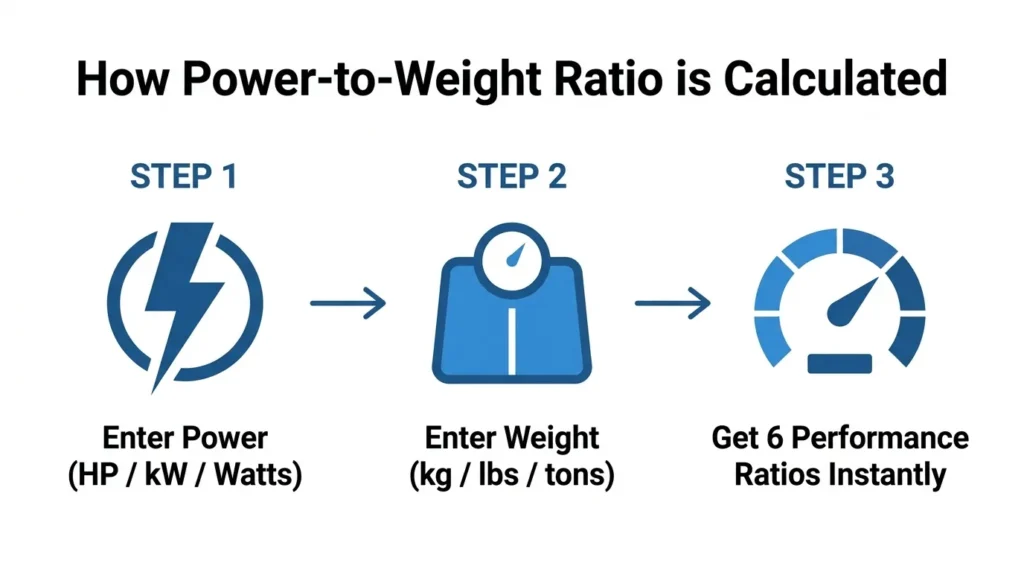
The tool requires just two inputs. Here’s exactly how to use it:
Step 1: Enter your power value. Type your engine’s power output into the “Power (HP, Watts, kW)” field. You can enter any number — whole or decimal.
Step 2: Select your power unit. Click the dropdown next to the power field. Choose from: Milliwatts, Watts, Kilowatts, Megawatts, Gigawatts, Horsepower (Imperial), Horsepower (Metric), or Joules per second.
Step 3: Enter your vehicle’s weight or mass. Type the weight into the “Weight / Mass (kg, lbs)” field. This is typically the vehicle’s curb weight.
Step 4: Select your weight unit. Click the second dropdown. Choose from: Grams, Kilograms, Pounds, Tons, Ounces, US Tons, or Long Tons.
Step 5: Read your six performance ratios. The “Performance Ratios” panel updates instantly. You’ll see:
- Watts per Kg (Cycling/Rowing)
- kW per Tonne (LAMS/P-Plater)
- MegaWatt per Kilogram
- Horsepower per Kilogram
- Horsepower per Pound (Drag Racing)
- Horsepower per Ton (Cars)
No “Calculate” button needed. Results appear the moment you enter your values.
Power to Weight Ratio Quick Reference Table
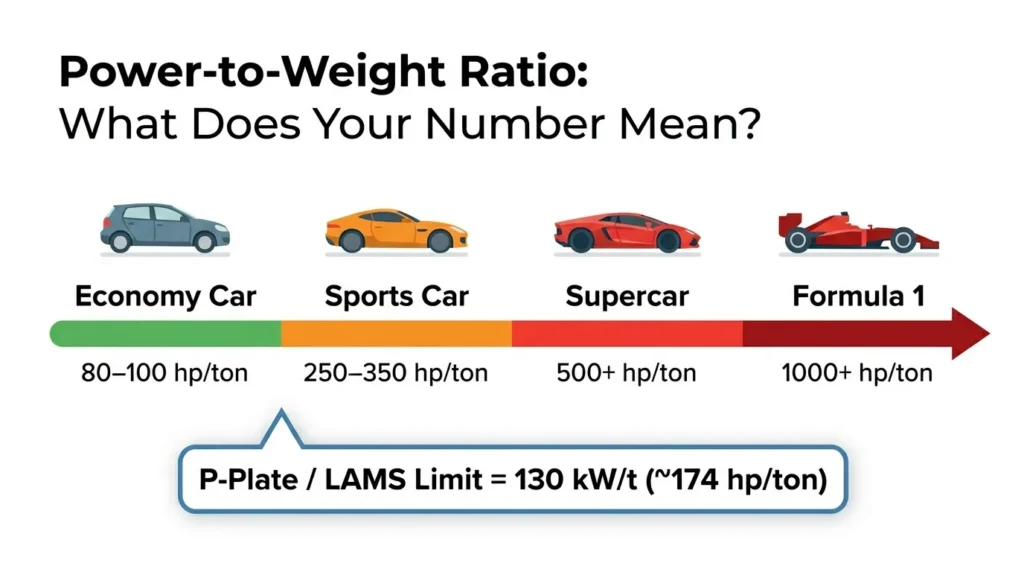
Use this chart to benchmark your result against common vehicle categories. It also shows the LAMS/P-Plate limit and estimated 0–60 mph acceleration times.
| Vehicle Category | Power Ratio (hp/ton) | Watts/kg | Est. 0–60 mph |
|---|---|---|---|
| Economy Car | 80–100 hp/ton | 60–75 W/kg | 10.0s+ |
| P-Plate / LAMS Limit | ~174 hp/ton | 130 W/kg | 7.0s–8.0s |
| Sporty Hatch | 180–220 hp/ton | 150 W/kg | 6.0s–7.0s |
| Sports Car | 250–350 hp/ton | 220 W/kg | 4.0s–5.5s |
| Supercar | 500–650 hp/ton | 400 W/kg | 2.8s–3.5s |
| Formula 1 / Hypercar | 1000+ hp/ton | 750+ W/kg | <2.5s |
Key insight: A higher ratio indicates better acceleration and overall performance. A lightweight car with moderate power often outperforms a heavy car with a large engine.
Accuracy & Privacy Guarantee
Every calculation runs entirely in your browser. No data is sent to any server.
What this means for you:
- Your vehicle’s power and weight data stays private
- Results are instant — no loading delay
- The formulas are standardised and accurate across all unit conversions
- The tool is 100% free with no sign-up required
All unit conversions use internationally recognised standards. The kW/tonne output is calibrated against the official LAMS threshold of 130 kW per tonne, making it fully reliable for compliance checks in Australia.
FREQUENTLY ASKED QUESTIONS (FAQ)
How do I calculate the power-to-weight ratio for my car?
Divide your engine’s power output by the vehicle’s curb weight using the same unit system. For example, a car with 150 kW and 1,500 kg has a ratio of 100 kW per tonne. This tool automates that calculation across 8 power units and 7 weight units simultaneously, saving you from manual conversion errors.
What is the LAMS power-to-weight ratio limit in Australia?
The LAMS (Learner Approved Motorcycle Scheme) and P-Plate car limit is 130 kW per tonne. Enter your vehicle’s power in kilowatts and weight in tonnes — the “kW per Tonne (LAMS/P-Plater)” output card will display your result instantly for direct compliance comparison.
Can I use this calculator for cycling or rowing performance?
Yes, this calculator outputs Watts per Kilogram (W/kg), the standard power-to-weight metric used in cycling and rowing. Enter your power output in Watts and your body weight in Kilograms to get your W/kg ratio — the key figure used to compare and benchmark endurance athletes.
What’s the difference between horsepower per pound and horsepower per ton?
Horsepower per pound (hp/lb) is the standard metric in drag racing, where every pound of weight is critical. Horsepower per ton (hp/ton) is the standard for comparing everyday cars and sports vehicles. This calculator displays both outputs simultaneously so you can use whichever metric is relevant to your context.