
Amps & kVA Converter
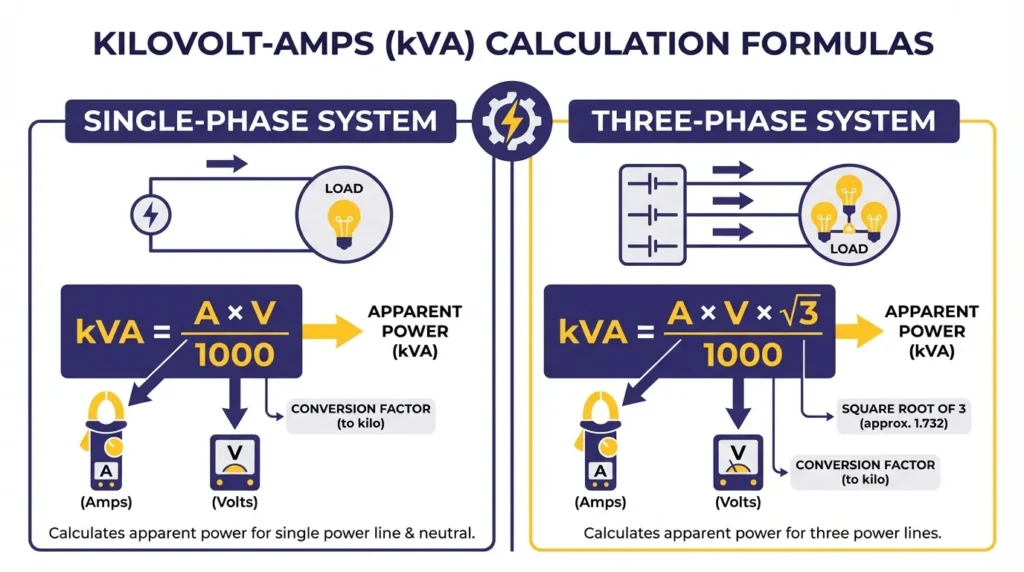
* Note: For three-phase calculations, Line-to-Line voltage is assumed. The formula used is kVA = (Amps × Volts × √3) / 1000.
Electrical calculations don’t have to slow you down. The Amps & kVA Converter on Calqro gives you instant, accurate results for both single-phase and three-phase systems — no formulas, no guesswork.
Whether you’re sizing a transformer or checking a circuit load, this free online calculator has you covered.
Understanding the Amps to kVA Conversion
Manual electrical calculations waste time and invite costly errors. Getting the wrong kVA rating for a transformer can damage equipment or trip a breaker.
Amps (A) measures electric current — the flow of electric charges through a conductor. kVA (kilovolt-amperes) measures apparent power, which is the total power a system draws. These two values are directly linked by voltage.
In real life, electricians and engineers constantly need to convert between them. You might need the correct kVA rating to size a generator. Or you might need the current in amps to check if a circuit breaker is appropriately rated.
This is exactly the problem the Amps & kVA Converter solves. It handles both directions — amps to kVA and kVA to amps — for single-phase and three-phase systems instantly.
Key Features & Capabilities
- Two conversion modes: Switch between “Amps to kVA” and “kVA to Amps” with one click.
- Single-phase & three-phase support: Covers both common electrical system types.
- Dual unit inputs: Enter current in amps and voltage in volts — both with dedicated input fields.
- Live apparent power output: The result updates immediately as you type.
- Correct three-phase formula built-in: Uses kVA = (Amps × Volts × √3) / 1000 automatically for three-phase calculations.
- 100% free online calculator: No account, no download, no hidden fees.
- Mobile-friendly design: Use it on-site from any device.
How to Use the Amps & kVA Converter (Step-by-Step)
The tool has two tabs: Amps to kVA and kVA to Amps. Here’s how to use each.
Converting Amps to kVA
- Click the “Amps to kVA” tab at the top of the calculator.
- Select your phase type from the Phase dropdown — choose either Single-phase or Three-phase.
- Enter your current value in the “Current” field. The unit is set to amps by default.
- Enter your voltage value in the “Voltage” field. The unit is set to volts by default.
- Read the result in the “Apparent Power” display box. The value updates instantly in kVA.
Converting kVA to Amps
- Click the “kVA to Amps” tab at the top of the calculator.
- Select your phase type from the Phase dropdown — Single-phase or Three-phase.
- Enter your kVA value in the top input field.
- Enter your voltage in the Voltage field.
- Read the result in the “Current” display box. The output shows in Amps instantly.
Note: For three-phase calculations, the tool assumes Line-to-Line voltage. The formula used is kVA = (Amps × Volts × √3) / 1000.
Amps to kVA Quick Reference Table
Use this table for fast, common amps to kVA conversions at standard voltages.
| Current (Amps) | Voltage (Volts) | Phase | Apparent Power (kVA) |
|---|---|---|---|
| 10 A | 120 V | Single-phase | 1.2 kVA |
| 20 A | 240 V | Single-phase | 4.8 kVA |
| 30 A | 240 V | Single-phase | 7.2 kVA |
| 50 A | 240 V | Single-phase | 12.0 kVA |
| 100 A | 415 V | Three-phase | 71.8 kVA |
| 200 A | 415 V | Three-phase | 143.7 kVA |
Formula used: Single-phase: kVA = (A × V) / 1000 | Three-phase: kVA = (A × V × √3) / 1000
Accuracy & Privacy Guarantee
The Calqro Amps & kVA Converter uses verified electrical engineering formulas. The three-phase calculation correctly applies the √3 multiplier — a common source of error in manual calculations.
Here’s what you can count on:
- ✅ 100% free — no subscription or sign-up required.
- ✅ Accurate formulas — both single-phase and three-phase formulas are built in.
- ✅ No data stored — your inputs never leave your browser.
- ✅ Always available — use it online from any device, any time.
- ✅ No power factor required — this tool calculates apparent power (kVA), not real power (kW), so no power factor (e.g., 0.8) is needed.
FREQUENTLY ASKED QUESTIONS (FAQ)
How do I convert amps to kVA for a single-phase system?
For a single-phase system, multiply amps by volts and divide by 1000 to get kVA. For example, 20 amps at 240 volts equals 4.8 kVA. Enter those two values into the Calqro calculator and the result appears instantly.
What is the difference between single-phase and three-phase calculations?
Three-phase calculations use the √3 multiplier (approximately 1.732), which single-phase calculations do not require. This tool automatically applies the correct formula based on the phase type you select from the dropdown. You don’t need to remember the different formula — the calculator handles it.
Do I need to enter a power factor to use this calculator?
No — this calculator converts amps to kVA, which is apparent power, not real power (kW). Apparent power does not require a power factor value. If you need to calculate real power in kilowatts, you would multiply the kVA result by the power factor (commonly 0.8).
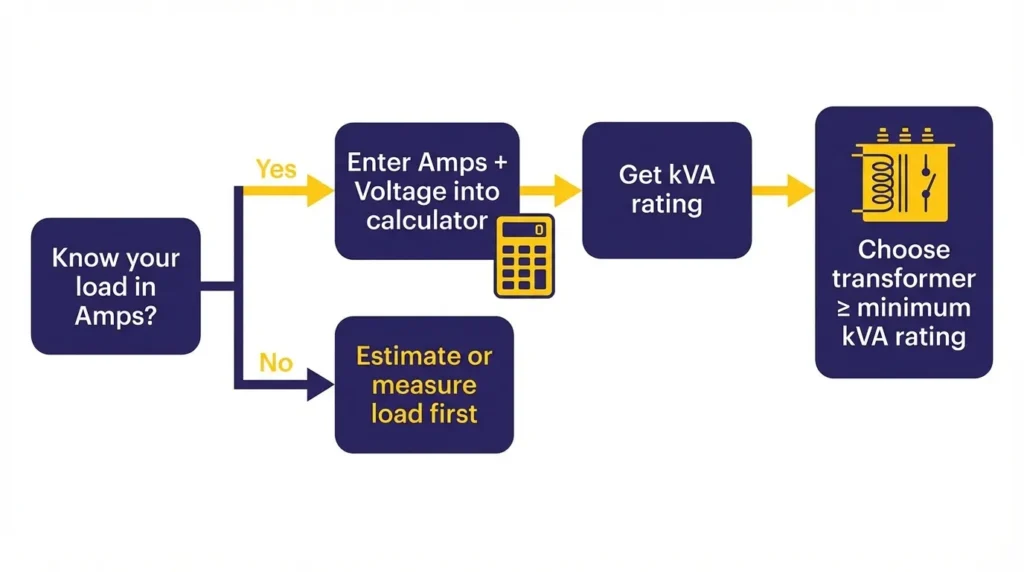
Can I use this to find the minimum kVA rating for a transformer?
Yes — enter the load’s current in amps and the system voltage to get the correct kVA value for transformer sizing. Always choose a transformer with a kVA rating equal to or greater than the calculated result. This ensures the transformer is not overloaded under full load conditions.