
Puppy Growth Calculator

* Note: Puppy growth is not perfectly linear. This estimation relies on standard growth curves. Genetics, diet, and individual health heavily influence actual mature weight.
Calculate Dog Age in Human Years →Knowing how big your puppy will get takes the guesswork out of raising a healthy dog. The Calqro Puppy Growth Calculator gives you an instant adult weight estimate based on your puppy’s current weight, age, and breed size category — so you can plan smarter from day one.
Quick Definition Box
What is a Puppy Growth Calculator? A puppy growth calculator estimates a dog’s adult weight using its current weight, age in weeks or months, and breed size category. It applies standard canine growth curves to predict how much your puppy will weigh when fully mature.
Understanding the Puppy Growth Calculator
Watching your puppy grow is exciting — but it comes with real questions. Will they fit in the crate you bought? How much food should they eat at six months? When do they stop growing?
Without a reliable dog weight calculator, most owners rely on guesswork or vague breed charts that don’t account for their puppy’s actual size right now.
That’s exactly what this tool fixes. Enter your puppy’s current weight, current age, and expected adult size category, and the calculator instantly predicts their adult weight using proven growth curve formulas. No vet visit required.
Why does this matter in real life?
- A family adopts a 3-lb mixed breed puppy at 8 weeks. They want to buy a dog bed and crate — but have no idea if their dog will reach 15 lbs or 50 lbs as an adult. The puppy weight calculator gives them a reliable starting estimate.
- A first-time dog owner feeding a large breed puppy needs to know their dog’s projected adult weight to follow the right feeding guide on the kibble bag.
- A pet owner tracking their puppy’s growth week by week uses the calculator to spot if their puppy is gaining weight at a healthy rate.
These are not edge cases. These are decisions every dog owner faces — and a fast, accurate puppy size calculator makes them easier.
Key Features & Capabilities
The Calqro Puppy Growth Calculator is built for accuracy and simplicity. Here’s what it offers:
- Current Weight Input: Enter your puppy’s weight in pounds (lbs) or kilograms (kg) — the weight unit dropdown lets you switch instantly.
- Current Age Input: Enter age in weeks or months, giving you flexibility whether your puppy is 8 weeks old or 5 months old.
- Expected Adult Size Category: Choose from size categories that reflect real canine maturity timelines:
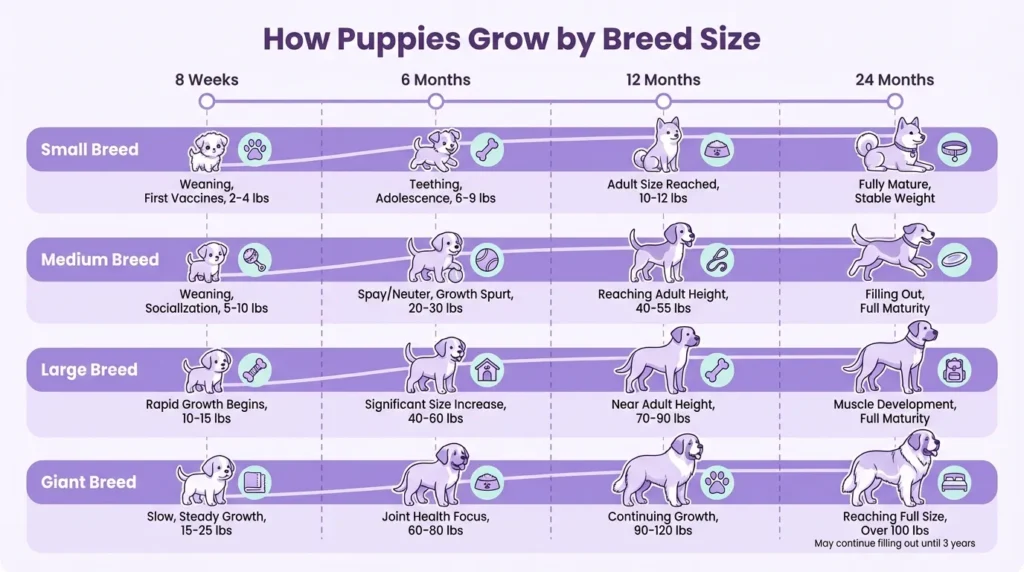
- Small Breed (matures at ~8–10 months)
- Medium Breed (matures at ~12 months)
- Large Breed (matures at ~15–18 months)
- Giant Breed (matures at ~18–24 months)
- Instant Adult Weight Prediction: Hit “Predict Adult Weight” and your puppy’s estimated adult weight appears immediately — no page reload.
- Growth curve disclaimer: The tool correctly notes that puppy growth is not perfectly linear, and that genetics, diet, and individual health influence actual mature weight. This keeps expectations realistic.
- Dog Age Calculator shortcut: A direct link to the Dog Age in Human Years Calculator sits right below the result — a natural next step for curious owners.
How to Use the Puppy Growth Calculator (Step-by-Step)
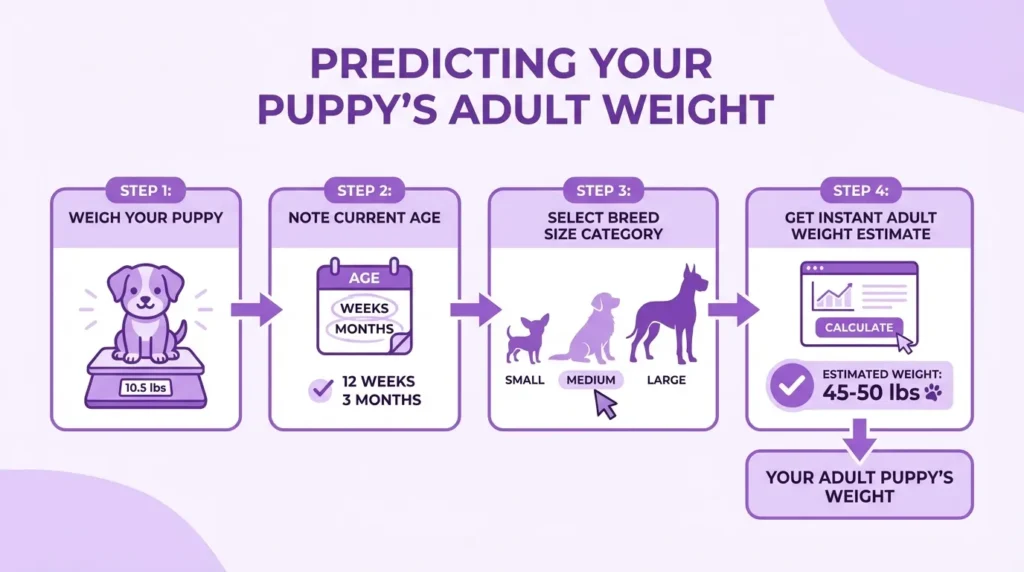
Using this dog weight calculator takes under 30 seconds. Follow these steps exactly as the tool interface shows:
- Enter your puppy’s current weight. Type a number in the “Current Weight” field. For example, enter
15for a 15-pound puppy. The field shows a placeholder of “e.g. 15” to guide you. - Select your weight unit. Click the “Weight Unit” dropdown and choose either Pounds (lbs) or Kilograms (kg) — whichever matches how you weighed your puppy.
- Enter your puppy’s current age. Type a number in the “Current Age” field. For example, enter
12for a 12-week-old puppy. - Select your age unit. Click the “Age Unit” dropdown and choose either Weeks or Months, depending on how you track your puppy’s age.
- Choose the expected adult size category. Click the “Expected Adult Size Category” dropdown and select the breed size that matches your dog: Small, Medium, Large, or Giant. If you have a mixed breed dog, choose based on the parent breeds or your vet’s estimate.
- Click “Predict Adult Weight.” The estimated adult weight appears instantly in the result box below the button, displayed in lbs.
- Review the result and disclaimer. The tool shows your puppy’s projected adult weight. Read the note below — it reminds you that genetics, diet, and health all play a role in your puppy’s actual final size.
Tip: If you want to also know your dog’s age in human years, click the “Calculate Dog Age in Human Years →” link below the result. You can also explore other tools in our pet calculators collection for more dog health insights.
Puppy Growth Calculator Quick Reference Table
Use this puppy growth chart as a fast reference to estimate adult weight based on current puppy weight and breed size. These are typical ranges based on standard canine growth curves.
| Current Weight (lbs) | Current Age | Breed Size | Estimated Adult Weight |
|---|---|---|---|
| 5 lbs | 8 weeks | Small Breed | ~10–14 lbs |
| 10 lbs | 8 weeks | Medium Breed | ~25–35 lbs |
| 15 lbs | 12 weeks | Large Breed | ~55–65 lbs |
| 20 lbs | 16 weeks | Large Breed | ~65–75 lbs |
| 10 lbs | 12 weeks | Giant Breed | ~80–110 lbs |
| 3 lbs | 8 weeks | Small Breed | ~6–10 lbs |
Note: These are general estimates. Use the calculator above for a personalized prediction based on your puppy’s exact weight and age.
Accuracy & Privacy Guarantee
The Calqro Puppy Growth Calculator is 100% free with no sign-up, no account, and no hidden fees — ever.
How accurate is it? The tool applies standard canine growth curve formulas used widely in veterinary guidance. These formulas use your puppy’s current weight, age, and breed size category to project adult weight. Because every dog is different, treat the result as a reliable estimate, not a guarantee. Genetics, diet, and individual health all shape your puppy’s final size — as the tool itself notes.
Your data stays private. This calculator runs entirely in your browser. No data you enter gets sent to or stored on any server. Your puppy’s information stays on your device — full stop.
Always up to date. The growth curve logic stays aligned with established veterinary standards, so you always get a calculation based on current best practices.
For a broader look at your dog’s health milestones, check the Dog Age Calculator — another free tool from Calqro’s pet calculator suite.
Frequently Asked Questions (FAQ)
How accurate is the Puppy Growth Calculator?
The calculator gives a strong estimate based on standard canine growth curves, but it is not a guarantee. Genetics, diet, health history, and whether your dog is the smallest puppy in a litter or the largest all affect actual adult weight. Use the result as a planning guide, and confirm with your vet at routine check-up visits.
What if I have a mixed breed dog?
Select the size category closest to your dog’s expected adult size based on the parent breeds. If you adopted your puppy without knowing the parents, your vet can give a size estimate based on the puppy’s current weight and bone structure. Mixed breed dogs typically fall within the growth patterns of their dominant parent breed.
When do puppies reach their adult weight?
Small breeds reach their adult weight at around 8–10 months of age. Medium breeds mature at roughly 12 months. Large breeds take 15–18 months, and giant breeds may not reach their final size until 18–24 months. This is why selecting the correct size category in the calculator matters — it directly affects the growth curve used to predict your puppy’s adult weight.
Can I use this as a puppy weight estimator for giant breeds like Great Danes?
Yes — select “Giant Breed (Matures at ~18–24 months)” from the Expected Adult Size Category dropdown. Giant breed puppies gain weight much more slowly relative to their final size, so the calculator applies a longer growth curve to give you an accurate adult weight estimate. Always pair the result with vet guidance for large dog breeds, since overfeeding a giant breed puppy can cause joint problems.