
AC & DC Converter
* Note: The DC to AC calculator uses inverter efficiency to determine AC power. The AC to DC simulation mathematically converts AC RMS voltage to DC voltage using standard rectifier approximations (V / √2).
Converting between AC and DC power no longer requires an engineering degree. The Calqro AC & DC Converter Calculator handles both DC-to-AC power conversion and AC-to-DC voltage conversion in seconds — giving engineers, solar installers, students, and everyday users instant, accurate results.
Definition
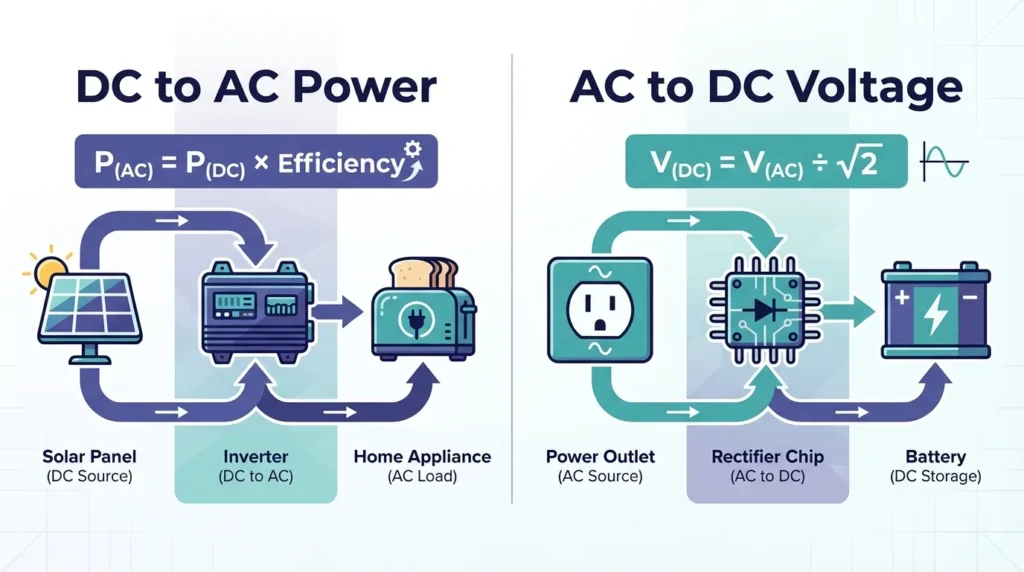
AC to DC Converter Calculator: A tool that converts AC RMS voltage to DC voltage using the formula V(DC) = V(AC) ÷ √2, and converts DC power to AC power output using the formula P(AC) = P(DC) × Inverter Efficiency. Used for solar systems, inverter sizing, and electrical circuit design.
Understanding the AC & DC Converter Calculator
Manual power conversion is tedious — and one wrong decimal can throw off an entire solar panel system or appliance setup. Whether you’re sizing an inverter for an off-grid cabin or calculating DC voltage from an AC circuit, doing this math by hand wastes time and introduces errors.
This is exactly where the AC & DC Converter Calculator earns its place.
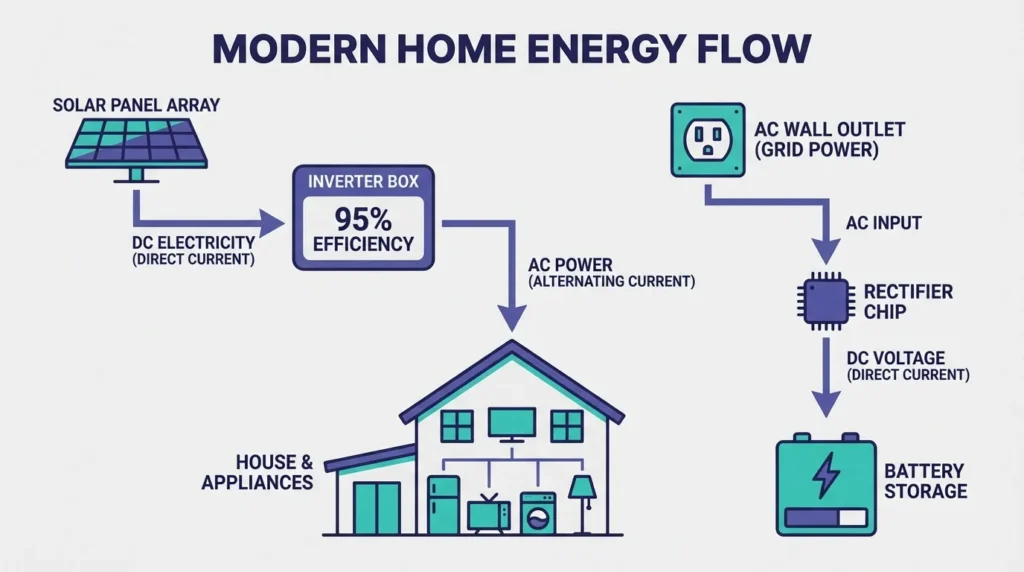
Take a practical example: a solar installer needs to know how much AC power a 200W DC solar panel system produces after passing through a 95% efficient inverter. Instead of hunting for the formula, they enter two values and get 190.00W instantly. Or consider an electronics student converting 500V AC RMS to its DC equivalent — the tool returns 353.55V using the standard rectifier approximation (V ÷ √2).
The tool covers both real-world needs in one clean interface.
Who uses it most?
- Solar and off-grid installers sizing inverters for battery banks
- Electrical engineering students working through AC and DC conversion problems
- DIY homeowners planning power setups for RVs, sheds, or backup generators
- Technicians verifying power supply specifications
Need to work with amperage too? Check out the VA to Amp Calculator or the Amps to kW Calculator for related electrical conversions.
Key Features & Capabilities
This AC to DC converter calculator packs a focused set of features that directly serve your conversion needs:
- Dual conversion modes: Switch between DC to AC (Power) and AC to DC (Voltage) with a single tab click — no separate tools needed.
- Inverter efficiency input: Enter your inverter’s real efficiency rating (e.g., 0.95 for 95%) to get accurate AC power output, not a theoretical maximum.
- Standard rectifier formula: The AC to DC voltage tab uses the industry-standard approximation (V ÷ √2) that matches real-world rectifier behavior.
- Instant results: No submit button, no loading screen — results display immediately as you enter values.
- Zero data collection: All calculations run locally in your browser. No account, no server-side data saving.
- Free forever: 100% free with no usage limits, ads, or paywalls.
- Mobile-friendly UI: Works cleanly on phones and tablets — useful on job sites or in the field.
For broader wattage and power calculations, the Power to Weight Ratio Calculator and HP to WHP Calculator are also worth bookmarking.
How to Use the AC & DC Converter Calculator (Step-by-Step)
The tool has two tabs. Here’s how to use each one.
Tab 1 — DC to AC (Power)
- Click the “DC to AC (Power)” tab (active by default).
- Enter your DC Power (P_DC) value in the first field — for example,
200watts. - Enter your Inverter Efficiency in the second field as a decimal — for example,
0.95for 95%. - Read the AC Power (P_AC) Result displayed instantly below. A 200W DC input at 95% efficiency returns 190.00W AC output, in the same unit as your input.
Tab 2 — AC to DC (Voltage)
- Click the “AC to DC (Voltage)” tab.
- Enter your AC Voltage in Volts — for example,
500. - Read the DC Voltage Result instantly. 500V AC returns 353.55 Volts DC, calculated using the standard rectifier approximation (V ÷ √2).
Note: The DC to AC tab uses inverter efficiency to determine AC power output. The AC to DC tab mathematically converts AC RMS voltage to DC voltage using standard rectifier approximations (V ÷ √2). It does not simulate a full rectifier circuit.
AC & DC Converter Quick Reference Table
Use this table as a fast reference for common DC-to-AC power conversions at typical inverter efficiencies, and standard AC-to-DC voltage conversions.
| Input Value | Type | Efficiency / Formula | Result |
|---|---|---|---|
| 100W DC | DC to AC Power | 0.90 (90%) | 90.00W AC |
| 200W DC | DC to AC Power | 0.95 (95%) | 190.00W AC |
| 500W DC | DC to AC Power | 0.85 (85%) | 425.00W AC |
| 1000W DC | DC to AC Power | 0.92 (92%) | 920.00W AC |
| 120V AC | AC to DC Voltage | V ÷ √2 | 84.85V DC |
| 240V AC | AC to DC Voltage | V ÷ √2 | 169.71V DC |
| 500V AC | AC to DC Voltage | V ÷ √2 | 353.55V DC |
Accuracy & Privacy Guarantee
Every calculation in this tool uses the same formulas electrical engineers and solar installers rely on daily:
- DC to AC Power:
P(AC) = P(DC) × Efficiency— the standard inverter output formula - AC to DC Voltage:
V(DC) = V(AC) ÷ √2— the standard rectifier approximation for peak-to-RMS conversion
Your data stays private. The tool runs entirely in your browser. Nothing is sent to a server, stored, or logged. You can use it as many times as you like with zero privacy risk.
It’s also completely free — no account required, no premium tier, no strings attached.
FREQUENTLY ASKED QUESTIONS (FAQs)
What is the formula used in the AC to DC voltage conversion?
The AC to DC voltage conversion uses the formula V(DC) = V(AC) ÷ √2, which is the standard rectifier approximation that converts AC RMS voltage to its equivalent DC voltage. This matches the real-world behavior of a basic diode rectifier circuit and is widely used in electrical engineering and power supply design. It’s the same formula textbooks, technicians, and online AC to DC converter calculators reference for quick DC voltage estimation.
How does inverter efficiency affect DC to AC power output?
Inverter efficiency directly reduces how much AC power you get from a DC input — a 200W DC source at 90% efficiency only delivers 180W of AC power output. No inverter converts power at 100%; energy is always lost as heat. Real-world solar inverters typically run between 85% and 97% efficiency. Always enter your inverter’s rated efficiency for an accurate AC wattage result rather than assuming a perfect conversion.
Can I use this calculator for solar panel system sizing?
Yes — the DC to AC Power tab is built for exactly this use case. Enter your solar panel’s DC power output and your solar inverter’s efficiency rating to instantly see how much AC power reaches your appliances or electricity grid. For a complete solar system calculation, pair this tool with the Amps to kW Calculator to cross-check your wattage and amperage figures.
Is this the same as converting AC amps to DC amps?
No — this tool converts AC voltage to DC voltage and DC power to AC power, not amperage directly. AC amps to DC amps conversion requires factoring in voltage and power factor separately. To convert between amps and other electrical units, use the VA to Amp Calculator or the Convert Amps to kVA Calculator for that specific calculation.