
Mesh to Micron Converter
Convert standard US Mesh sizes to Microns (μm), Millimeters (mm), and Inches. Enter a value, then click calculate.
Conversion Summary
Stop guessing particle size. This mesh to micron converter translates any standard US Mesh size into Microns (µm), Millimeters (mm), and Inches in one click — no manual chart hunting, no math errors.
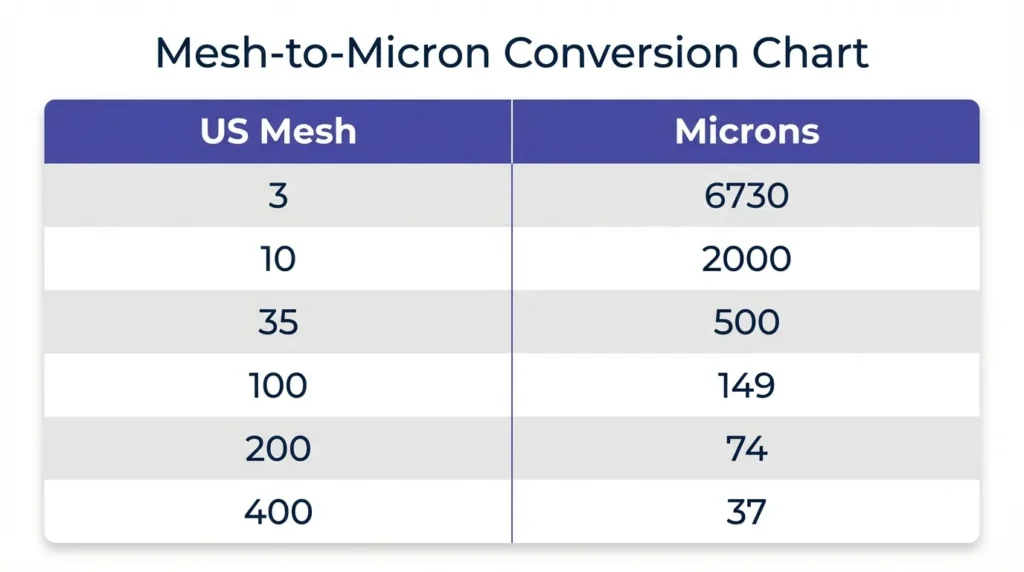
Quick Definition: A mesh size is the number of openings per linear inch in a screen or sieve. The mesh to micron conversion tells you the actual opening size in microns (µm). Higher mesh numbers mean finer particles and smaller openings — 35 Mesh equals 500 µm, while 400 Mesh equals just 37 µm.
Mesh Size and Micron: Why the Confusion Exists
Mesh and micron measure the same thing — particle size — but from opposite angles. Mesh counts the number of openings per linear inch; microns measure the physical diameter of each opening.
This disconnect causes real problems in powder processing, filtration, and material handling. A supplier quoting “200 Mesh” and a lab requesting “74 µm” are describing the exact same particle size — but without a reliable tool to convert, procurement errors and batch failures happen.
Industries like milling, pharmaceuticals, and bulk powder manufacturing depend on precise mesh-to-micron alignment to control flow rates, density, and product quality. If you also work with large-scale distance measurements, our Astronomical Unit Calculator and Light Year Conversion Calculator handle the other end of the measurement spectrum.
The Mesh-to-Micron Conversion Formula
The standard approximate formula used across the industry is:
Microns (µm) = 25400 / Mesh Number x Wire Diameter Adjustment
For practical purposes, most engineers use a simplified lookup-based approach because wire diameter varies by material and screen design. The formula below gives a quick approximate result:
µm ≈ 25400 / Mesh Number
Example: 35 Mesh → 25400 / 35 ≈ 726 µm (raw estimate)
The actual ASTM-standardized value for 35 Mesh is 500 µm — which is why this tool uses verified ASTM E11 standard values rather than a raw divide calculation.
Limitations to know:
- The formula produces approximate results. Wire diameter, weave pattern, and screen material all affect the true opening size.
- This tool covers standard US Mesh sizes. Non-standard or Tyler mesh series may differ.
- For particle size reduction processes below 400 Mesh (37 µm), consult your equipment manufacturer’s sieve specification sheet directly.
Converting Mesh to Micron: A Step-by-Step Example
Scenario: A pharmaceutical lab technician, Sara, needs to confirm that her 120 Mesh stainless steel screen will pass particles no larger than 130 µm for a tablet filler formulation.
Step 1: Identify the mesh number → 120 Mesh
Step 2: Look up or convert using the tool → 120 Mesh = 125 µm
Step 3: Compare to the spec → 125 µm is within the acceptable range for her filler material (target: ≤ 130 µm) ✓
Step 4: Cross-check in millimeters → 0.125 mm — matches her equipment’s opening measurement stamped on the sieve frame ✓
Sara confirms the screen without any guesswork. The same logic applies whether you’re sizing abrasive powders, cement, or agricultural material. For unit conversions at a different scale, the Decimeter to Meter Converter follows the same zero-friction workflow.
Common Mistakes When Using Mesh or Micron Values
1. Confusing mesh number with micron value directly. A 100 Mesh screen has a 149 µm opening — not 100 µm. The numbers are not interchangeable. Always run the conversion.
2. Using the raw division formula as a precise standard. The formula (25400 / Mesh Number) gives a useful estimate but should never replace ASTM-standardized values for regulated applications like pharmaceutical or food-grade screening.
3. Ignoring wire diameter in the calculation. Two screens both labeled “200 Mesh” can have different actual openings depending on the wire gauge used. For critical applications, always verify with the manufacturer’s mesh conversion table or sieve certificate.
4. Mixing US Mesh and Tyler Mesh series. These two systems are similar but not identical. Confirm which standard your supplier or equipment uses before converting mesh and micron values for procurement.
How to Use the Mesh to Micron Converter
Based on the tool interface:
- Select your US Mesh Size from the dropdown on the left. The list runs from 3 Mesh (6730 µm) down to fine sizes like 400 Mesh (37 µm) — covering the full standard range used in industrial and lab applications.
- Click “Calculate Conversion” — the tool instantly populates three output fields: Microns (µm), Millimeters (mm), and Inches (in).
- Read the Conversion Summary displayed in large text below the inputs (e.g., 35 Mesh = 500 µm) — easy to screenshot or share.
- Use “Reload Calculator” to reset all fields, “Clear All Changes” to wipe outputs, or “Print” and “Share” to export your result directly.
No manual entry needed. No chart to cross-reference. Select, click, read.
Why This Tool Delivers Accurate, Reliable Results
This mesh to micron converter is built on verified ASTM E11 standard values — the same reference used by laboratories, industrial engineers, and quality control teams worldwide. It’s 100% free, requires no login, and works on any device.
Results display in three units simultaneously (µm, mm, and inches), eliminating the need for a secondary calculator. The tool is updated to reflect current standard mesh sizes, making it a dependable micron calculator for both quick lookups and professional documentation. For authoritative mesh and sieve standards, refer to the ASTM E11 Specification published by ASTM International.
FAQs About Mesh to Micron Conversion
What is the micron equivalent of 200 Mesh?
200 Mesh equals 74 µm (microns). This is one of the most referenced sizes in powder processing and pharmaceutical screening, corresponding to 0.074 mm or approximately 0.0029 inches.
Is the mesh to micron conversion the same for all screen materials?
Not exactly. The standard conversion chart values assume a specific wire diameter per mesh number based on ASTM E11. Screens made with thicker wire will have smaller actual openings than the nominal micron value, even at the same mesh number. Always verify with your screen supplier’s certificate for regulated applications.