
Dog Age in Human Years

* Note: Dogs mature much faster than humans in their first two years. After that, the ratio of dog years to human years varies significantly based on the size and breed of the dog.
The old “multiply by 7” rule is scientifically outdated. Our free dog years to human years calculator gives you a breed-specific, size-adjusted result in seconds — built on the latest veterinary research and AVMA dog years guidelines.
Quick Definition A dog years to human years calculator converts your dog’s chronological age into a human-equivalent age. It accounts for breed size and life stage, since dogs — especially puppies and senior dogs — age at dramatically different rates than a simple 7x multiplier suggests.
Why the 7-Year Rule Gets Dog Age Wrong
Most dog owners have heard it: one dog year equals seven human years. It’s simple, memorable, and largely wrong.
Dogs mature far faster than people in their first two years of life. A 1-year-old dog is closer to a 15-year-old teenager in biological terms. By age two, that same dog has reached the equivalent of a young adult in their mid-twenties.
After that early acceleration, aging slows down — and it varies significantly by breed and size. Small dogs like Chihuahuas and Yorkshire Terriers live longer than larger breeds. A 10-year-old Chihuahua is in a different life stage than a 10-year-old Mastiff.
This is why calculating dog years accurately matters. It helps you make smarter decisions about your dog’s food, health care, and vet visits.
How the Calculation Actually Works
There are two main frameworks veterinarians and researchers use today.
The Size-Tier Method (AVMA Standard)
The American Veterinary Medical Association (AVMA) breaks dog aging into size categories:
- Small breeds (under 20 lbs): Age slower after their first two years
- Medium breeds (21 – 50 lbs): Follow a moderate aging curve
- Large breeds (51 – 90 lbs): Age faster in middle and senior years
- Giant breeds (90+ lbs): Age the fastest — a 7-year-old Great Dane is already senior
The general guideline for the first two years applies to all sizes:
- Year 1 = ~15 human years
- Year 2 = ~9 additional human years (total ~24)
- Each year after = roughly 4 to 5 human years (varies by size)
The Epigenetic Formula (UC San Diego, 2019)
Researchers at the University of California San Diego published a 2019 study using DNA methylation patterns to build a more precise model. Their formula applies the natural logarithm of a dog’s age:
Human Age = 16 x ln(dog's age) + 31
This formula accounts for the rapid aging young dogs experience and the slower rate seen in senior dogs. It’s more accurate for individual dogs but less intuitive than the size-tier approach.
Our calculator combines both frameworks — using size tier as the primary model and applying breed-level adjustments where relevant.
Expert Pro-Tips: 3 Mistakes Dog Owners Make When Calculating Age
1. Using the same formula for all breeds Labrador Retrievers and Chihuahuas are both common breeds, but their aging trajectories differ significantly. Always select the correct size category — or use the breed dropdown — for an accurate result.
2. Ignoring the puppy phase entirely Many owners calculate dog age only for adult dogs. But puppy age to human equivalent matters enormously for setting vaccination schedules, spay/neuter timing, and nutrition. A 4-month-old puppy is roughly a 5-year-old child — still growing fast.
3. Treating the result as a medical diagnosis The human-age equivalent is a useful estimate — not a clinical measure. Use it as a conversation starter with your veterinarian, not a replacement for regular wellness checkups. The AVMA recommends twice-yearly vet visits for dogs in senior life stages.
What Your Dog’s Human Age Actually Means
Once you have the number, here’s what to do with it.
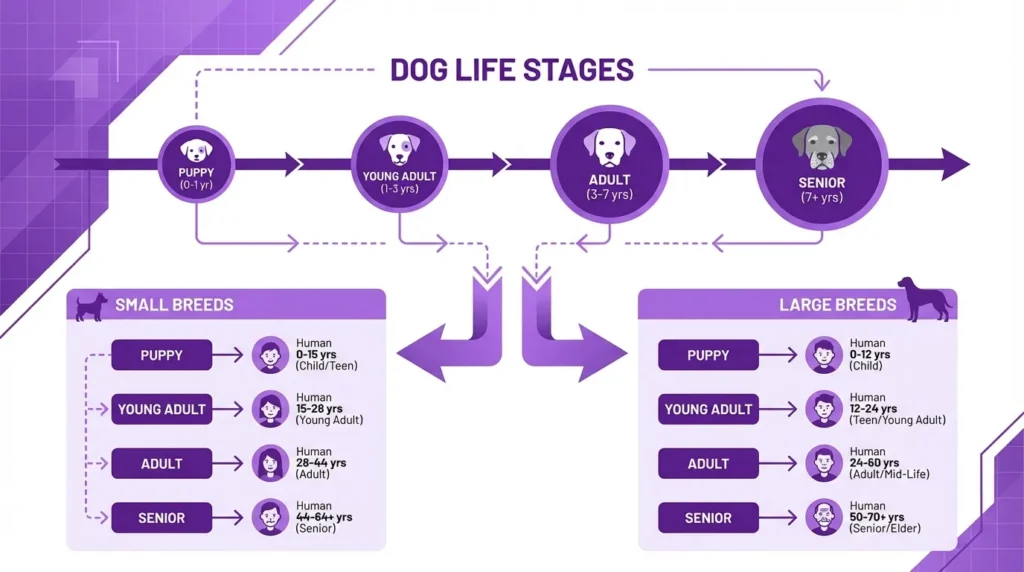
Young adult equivalent (20s–30s in human years): Your dog is in peak physical condition. Focus on active exercise, a balanced diet, and preventive care.
Middle age equivalent (40s–50s): Watch for early signs of joint stiffness, weight gain, or dental disease. This is a good time to discuss senior dog food options with your vet.
Senior equivalent (60s and above): Your dog needs more frequent vet visits, potentially joint supplements, and softer dog food. Larger breeds reach this stage earlier — a 7-year-old large breed dog is already in this zone.
Knowing your dog’s life stage helps you give them the right care at the right time.
How to Use the Dog Age Calculator: Step-by-Step
The tool has four input fields. Here’s exactly how to use each one.
- Select Dog Size Category — Choose the dropdown that matches your dog’s weight: Small (under 20 lbs), Medium (21-50 lbs), Large (51-90 lbs), or Giant (90+ lbs). This is the most important field.
- Select Breed (Optional) — Pick your dog’s specific breed from the list: options include American Foxhound, Beagle, Border Collie, Bulldog, Chihuahua, German Shepherd, Golden Retriever, Great Dane, Labrador Retriever, Mastiff, Pug, Saint Bernard, and Yorkshire Terrier, plus a Mixed/Custom option. Selecting a breed fine-tunes the result beyond size alone.
- Enter Dog’s Age (Years) — Type your dog’s age in whole years. If your dog is under 1 year, enter 0 and use the months field.
- Select Months — Use the dropdown to add additional months to the calculation. This matters most for puppies and young dogs where a few months equals significant development.
- Click “Calculate Human Years” — The result appears instantly below the button, showing your dog’s approximate human-equivalent age in large, bold text.
- Print or Share — Use the Print Result or Email / Share buttons to save your result or send it to your vet or family.
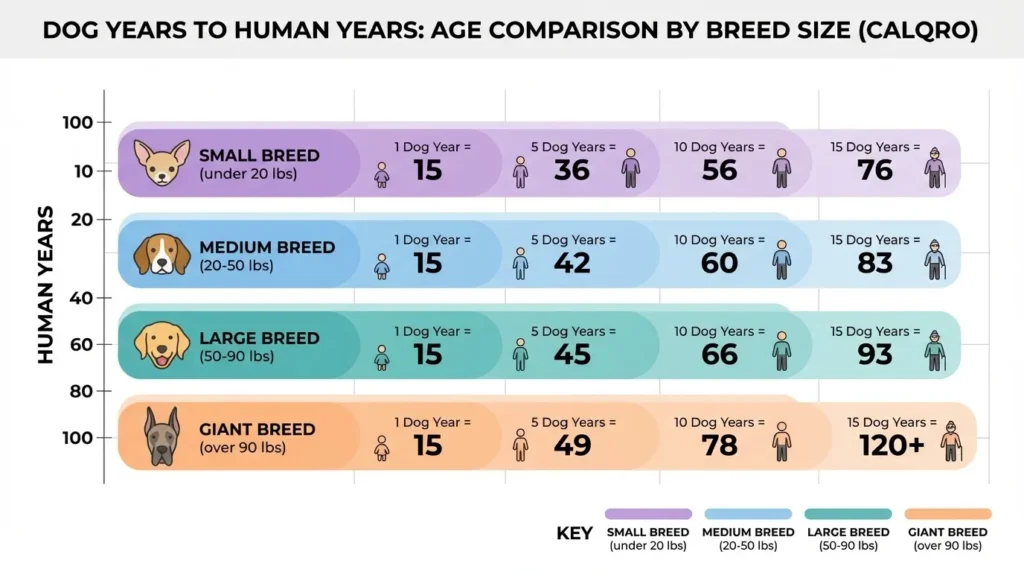
Dog Years to Human Years Chart: Quick Reference by Size
| Dog’s Age | Small Breed | Medium Breed | Large Breed | Giant Breed |
|---|---|---|---|---|
| 1 year | ~15 yrs | ~15 yrs | ~15 yrs | ~12 yrs |
| 3 years | ~28 yrs | ~29 yrs | ~31 yrs | ~35 yrs |
| 5 years | ~36 yrs | ~38 yrs | ~42 yrs | ~48 yrs |
| 8 years | ~48 yrs | ~52 yrs | ~58 yrs | ~66 yrs |
| 10 years | ~56 yrs | ~62 yrs | ~68 yrs | ~78 yrs |
| 13 years | ~68 yrs | ~74 yrs | ~82 yrs | ~96 yrs |
Values are estimates based on AVMA size-tier guidelines. Individual dogs may vary.
Accuracy You Can Count On
This dog age calculator is 100% free and requires no account, no sign-up, and no personal data. Your inputs are not stored on any server.
The formulas are built on published veterinary standards from the AVMA and reflect findings from peer-reviewed research including the 2019 University of California San Diego epigenetic aging study. We update the calculation logic whenever new clinical standards are published.
The result is clearly labeled as an estimate — because honest tools don’t overpromise. Use it as a reliable starting point for conversations with your veterinarian about your dog’s life stage, dog food needs, and age-related health care.
Also Try:
- Puppy Growth Calculator — Track your pup’s weight and growth milestones by breed
- Cat Age Calculator — Convert your cat’s age to human years with the same accuracy
Frequently Asked Questions (FAQ)
Is 1 dog year really equal to 7 human years?
No. The seven-year rule is a rough general guideline, not an accurate formula. Dogs age much faster in their first two years — year one alone equals roughly 15 human years. After that, aging varies significantly based on breed size and genetics.
How do I calculate dog years for a large breed like a Labrador Retriever?
Select “Large Breeds (51-90 lbs)” in the size dropdown, then choose Labrador Retriever from the breed list. Enter the dog’s age in years and months, then click Calculate. Labrador Retrievers are considered senior dogs around age 7-8, which corresponds to their mid-to-late 60s in human equivalent years.
What age is considered a senior dog in human years?
Most veterinarians consider a dog senior when it reaches approximately 60 human-equivalent years. For large and giant breeds, this can happen as early as 6-7 dog years. For smaller breeds, senior status typically begins around 10-11 dog years. Our calculator flags this life stage automatically in the result.
Does dog food and nutrition affect how fast a dog ages?
Yes. A balanced diet rich in appropriate protein, healthy fats, and age-specific nutrients supports longevity in dogs. Poor nutrition — particularly overfeeding or feeding low-quality dog food — is linked to faster aging and shorter lifespans in both small dogs and large breeds. Always consult your veterinarian for breed- and life-stage-specific feeding guidance.